
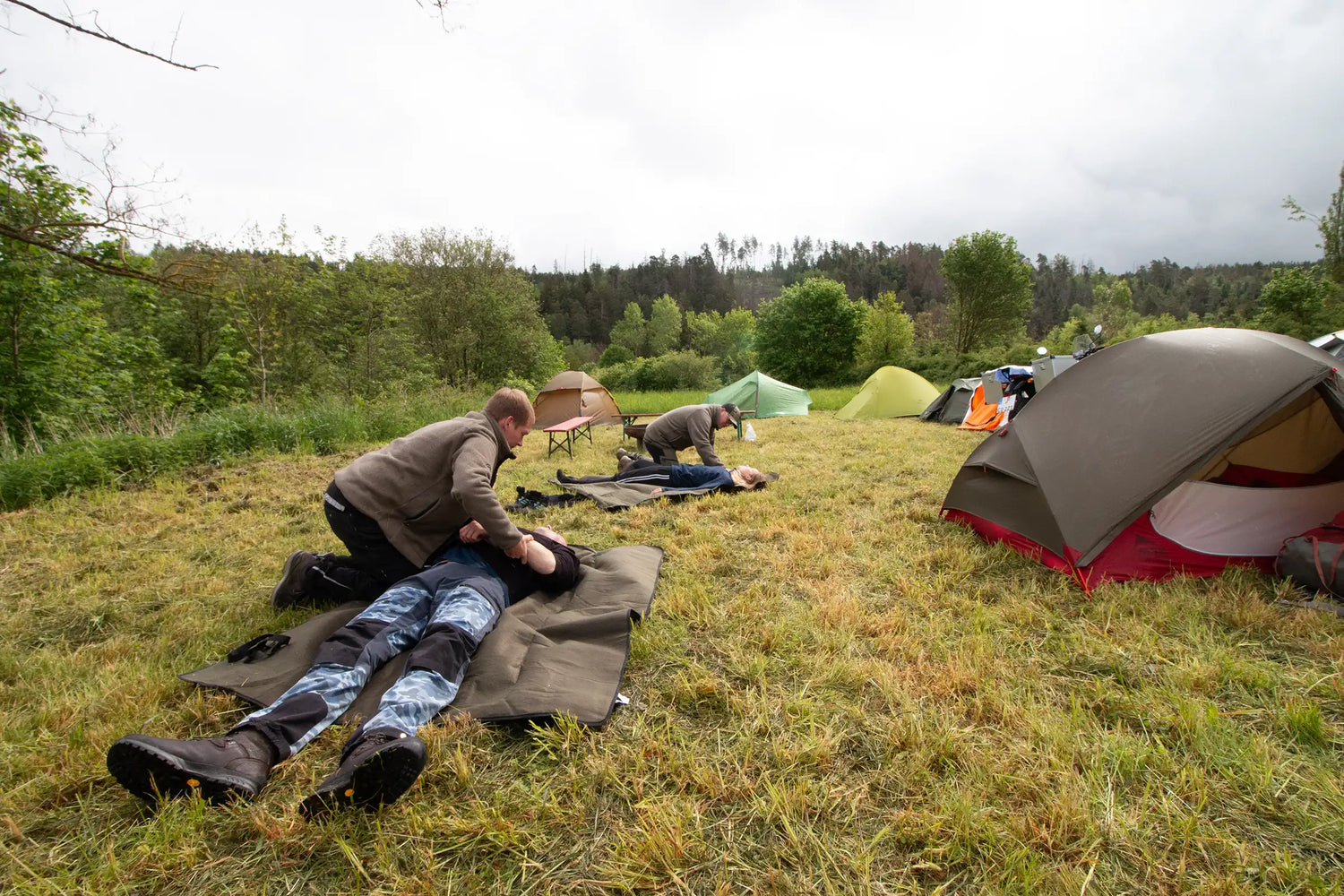
In January of this year, I had a conversation with my 12-year-old niece. The conversation can be summarized as follows:
Niece: “ Hey Thorsten, what exactly do you guys do at Hinterlandmedics again? ”
Me: “ We train people in outdoor first aid and expedition medicine. So they can help if someone happens to them outdoors. Pretty cool, right? ”
Niece: “ Well, it’s okay. ”
Me (visibly trying to maintain my composure): “ Um, well, I think it’s pretty cool when I can help others.” “Wouldn’t you like to learn that too? ”
Niece: “ Mmm. No. “Will you give me another slice of bread? ”
Admittedly, if you ask children and teenagers such closed-ended, leading questions, you have to expect to get your shins verbally attacked. And let's be honest, I celebrated completely different things when I was 12. For example, making empty milk cartons pop in the schoolyard. Or collecting those Diddl scented wrappers.
While those things are more a thing of the past, I could have this conversation every single day. With every age group. First aid has about the same popularity in Germany as the German railway, which is running late again as I write this. Annoying, but necessary.
Like many other providers, we no longer call our courses first aid courses. Otherwise, everyone just remembers the dry, lecture-style explanation from their driver's license, and with gritted teeth. Our survey from last year, in which we analyzed over 1,000 responses, confirms this. The main reasons for postponing course attendance were time, money, and outdated teaching methods. While aid organizations have been catching up in terms of teaching methods for years, Deutsche Bahn (German Rail) has also had a rail network renovation program in place since 2024. Neither of these things is being discussed.
Instead of improving first aid teaching methods, two other motives are often used to make first aid more socially acceptable: appeals to the idea that helping is a social obligation and the generation of fear. This type of communication worked very well for a while. In the last 10 years, the rate of layperson resuscitation (CPR) increased by a remarkable 15% to a total of 50% (how often laypersons perform CPR in cases of cardiac arrest). Since 2022, it has stagnated. Thus, even today, every second person who suffers cardiac arrest dies irretrievably. That's more than 10,000 preventable deaths per year.
At this point, I would like to briefly summarize a few facts and then ask an open question.
According to the Federal Agency for Civic Education, one in ten people felt lonely in 2021. In addition, screen time has been steadily increasing for years, currently reaching 3.5 hours per day. AI is gradually taking over a portion of what used to be human interaction. And since the pandemic, more and more people are working from home. These factors alone are potential indicators of a diminished social life. Doesn't this also potentially lower our sense of social obligation?
The same applies to fear. Yes, fear is extremely useful from an evolutionary perspective, because it prevents us from doing stupid things. Without fear, we as a species would no longer exist on the planet. Additionally, it's a powerful motivator, as we want to avoid unpleasant feelings. This includes the helpless experience of witnessing the death of our family and friends. The problem, however, is that when we promote first aid using fear as a tool, people also want to avoid the resulting unpleasant feeling. They either attend a course, or they immunize themselves against these thoughts in the long term. Then statements like " That won't happen to us " emerge. And once they've mentally reached that point, it's very difficult to reach them with the arguments currently being used.
But how do you communicate why first aid is really important?
A fundamental marketing problem with first aid is the fact that 99% of the time, the skills learned are used for the benefit of others. If first aid could instead be used for self-improvement, we would have an unmanageable number of dubious first-aid coaches. Altruism isn't exactly a blockbuster at first glance. Yet the feeling of helping others is one of the strongest and most beautiful feelings one can reward oneself with. Depending on the source, this helping frenzy is compared to enjoying a truly legendary meal, sex, or even a mild morphine high. We feel incredibly good when we carry Grandma Erna's groceries upstairs or stick a smiley-face bandage on Timmy's soothing wound. And like everything that's awesome, this trip is still a subculture. Here, we're convinced that much depends on how we talk about it. If I were to ask who's up for sending society into a frenzy of happiness, I think I'd see a lot more hands raised.
And helping others is also contagious. It's proven that people who receive good deeds feel encouraged to do good for others themselves. We saw this most recently during the large protests against the far right before the 2025 federal election. Unfortunately, the world doesn't stop moving after the election. And these days, the common good and social cohesion are becoming increasingly important again. It's foreseeable that crises, both large and small, will increase in the future. That we need more self-efficacy to confront the growing anxiety. So that we don't eventually distort reality for ourselves and become ignorantly immune. Self-efficacy for a time when we are experiencing a restructuring of the global order, while heads of state seem to be chosen primarily for their meme potential. When development aid is being slashed and climate change is being downplayed with hostility towards science. I'm not saying that first-aid courses are the solution to all our problems. But the inner hippie in me is finding a whole new meaning in the phrase "Let's get high together!". When we take responsibility for each other, we automatically have the freedom to grow through new challenges. Because knowing a few simple tricks makes even the most helpless situations manageable.
I admit that when writing about altruism, it's easy to slip into flowery prose. Perhaps that's exactly what happened to me just now. For those who, after reading this, still aren't convinced by the idea of "selfless" helping, let me say this: According to the Harvard Grant study, close, trusting relationships are the strongest predictor of a longer, happier, and healthier life. The fact that almost half of the German population feels unsure about administering first aid presents a significant opportunity. We can sustainably promote cultural helpfulness, social cohesion, and empathy through increased first aid education. And ultimately, this can lead to a better life for you personally.
Please learn first aid. For others. And for yourself.