
Wanderlust from a medical perspective
"We have an emergency!" shouts one of the group.
During a hiking expedition, we ventured into the jungle for several days. The vegetation is so dense that even at midday, a hazy veil hangs over the musty-smelling undergrowth. "Markus has hacked his leg with a machete and is bleeding like crazy!" In no time at all, a crowd of people surges to the scene. Instructions are barked out curtly, blood seeping into the already saturated jungle floor under their hands. They stuff bandages, reassure each other, check vital signs, and plan the evacuation. All in a movie-worthy 10 minutes. Then everyone hears me shout "Stop!" A thank you follows to everyone involved for this exercise.
This leads us into the debriefing session of one of our regular first aid training courses for Wandermut team leaders. We discuss what went well, where there were problems, and whether measures and diagnostics were taken at the right time. Then we discuss how such emergencies could be handled even more effectively in the future.
Anyone who pictured the opening jungle scene when they heard "Expedition Medicine" will be disappointed. Of course, such a situation can occur.
But the greatest efforts are focused on preventing such horrific scenarios. Because, as with wanderlust, expedition medicine is primarily about prevention. In this article, I'd like to take you through two days as an example to give you a glimpse into my work as an expedition medic.
Day 1, Home Office
The alarm rings, it's 7:00. Bravely, I switch it off without hitting snooze. I then realize that the day begins with a full WhatsApp inbox. The bright screen burns images of sandy feet and a laceration on some unidentifiable body part into my retina. Finally, I quickly read the question of whether antibiotics might be helpful for diarrhea. With a sigh, I go to the bathroom and make myself a coffee. In my head, I jot down a to-do list. A long day lies ahead.
Telemedicine
Sipping my coffee, I tackle the questions directly. The foot is swollen; a stress fracture is suspected. I request a more detailed description of the symptoms, including medical history and photos of the feet free of sand. Then I explain a few tests and pressure points and, in true "Black Forest Clinic" style, recommend rest. At the same time, I remind myself about the planned seminar on proper wound documentation, which I should finally prepare and deliver for Wandermut.
The laceration was treated in time. I'm getting new pictures of a sexy taped wound. I praise the Steri-Strips and give...
Instructions for antiseptic care, wound monitoring, and dressing changes. Inquire about the tetanus status and the exact location of the wound. I'll write "Wound Documentation Seminar" on a piece of paper.
Creating SOPs
After a large gulp of coffee, I looked up the current guideline on diarrhea. Then I began a leisurely half hour of self-study. I had originally intended to reply generally that, except in the rarest of cases, antibiotics are generally not advisable (1). That would have been the correct approach for this particular inquiry. However, I found a better scheme in the guideline for differentiating between "normal" and "severe" diarrhea, which I reviewed along with a few other things.
included therapy recommendations in our internal documents.
It was only last year that I truly realized how difficult it is to stay up-to-date. That alone makes it worthwhile to invest time in my own professional development. In addition, this approach has often saved me from spouting outdated nonsense.
Further training
Satisfied, I lean back with my last sip when Paddy from Wandermut headquarters calls. We discuss the next training course: where I saw room for improvement last year, what he noticed, and what feedback we received from the Wandermut team leaders. The result is a healthy mix of theory and practice, starting with the obligatory review of x and A (bleeding and airway obstruction) from the xABCDE scheme . This is followed by a repetition of the diagnostic procedure and the decision criteria for when evacuation is necessary. After a
During the lunch break, we will go into the forest. There, we will conduct and analyze case studies, such as the one described above.
medical equipment
Afterwards, we chatted a bit about the Wandermut Pharmacy and the equipment adjustments resulting from recent training courses. As is often the case in the private sector, this process is quite contentious. Additional medical equipment costs money. However, I've come to appreciate these kinds of discussions. Often, during all the preparation, one can become a bit blind to the obvious, and in the discussion about what's truly necessary, a lot of unnecessary medical "over-provision" gets discarded. The requirements for a first-aid kit that is effective, easy to use, and covers all relevant emergencies while being compact and lightweight are enormous.
After the discussion, I quickly revise the materials lists as my last task for the day. I'm just about to leave for the day when my phone rings again. New information and images regarding the stress fracture. Based on the medical history and symptoms, this seems rather unlikely. I look at the images, see a lot of sand again, take my notepad, and circle the wound documentation section several times. But that's a problem for tomorrow.
Day 2, On Wandermut Tour
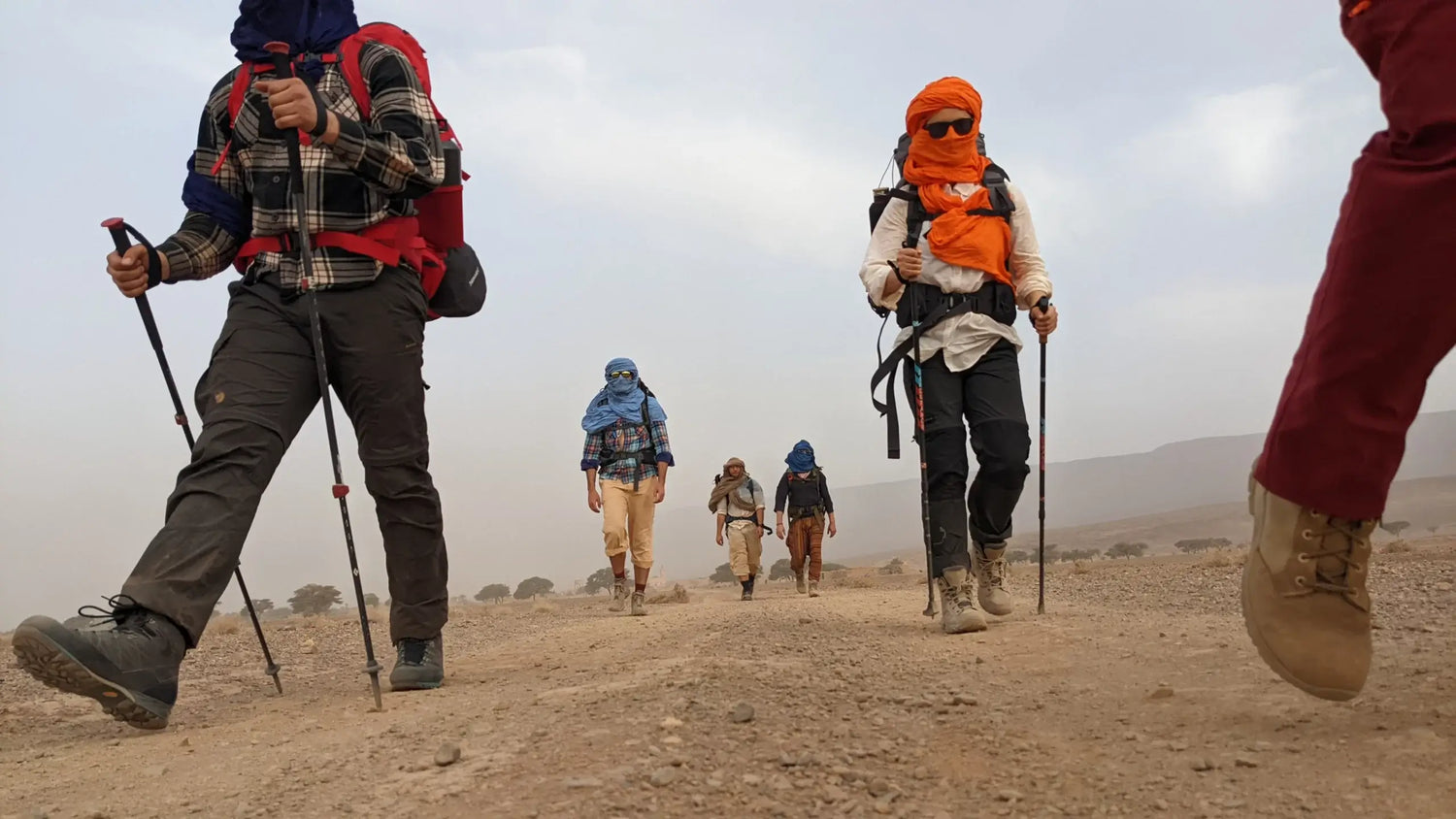
Scene change. Wandermut tour in the Sahara. The alarm rings promptly at 6:00 a.m., just as the sun rises. Shivering, I wipe sand from my face. The previous evening, we couldn't pitch our tents because of the sandstorm and huddled behind our backpacks for wind protection. The night was correspondingly uncomfortable, but free exfoliation is always welcome. While peeing, I almost trip over a scorpion. Then the first rays of sunlight tickle my nose, I sneeze, and sandy-brown mucus comes up. This is what life feels like! The rest of the group peels themselves out of their sleeping bags, the scent of fresh shakshuka enlivening the beautiful wilderness. At breakfast, we discuss today's route one last time. Then, I attend to about 30 blisters on the participants' feet, like visiting the rest of the group. Big blisters, small blisters, deep blisters, and my personal nightmare: blasception. These are blisters under old blisters. Deep, painful, and with a high potential for infection.
It's day eight, and although we're now sharing all our first aid supplies due to a lack of materials, we have to start improvising today. We're making toe bandages from cut-off glove fingers, using the semi-sterile plastic packaging of compresses, and even using duct tape.
Then there's another big gulp of instant coffee. In civilization, I wouldn't touch the stuff with a ten-foot pole, but out here it's black gold. We start the day a bit stiffly, but after an hour everyone's warmed up and we pick up the pace. Because in no time at all, a pleasant warmth turns into a sticky heat. Today we're moving particularly fast, running through a basin of table mountains. The rocks concentrate the sun's rays like a parabolic mirror in the valley. It's a melting 43 degrees Celsius.
Emergency treatment
While I was pondering whether a sandstorm would cool things down and thus improve the situation, or simply make it worse (a sandstorm generally makes things worse; it doesn't cool, but rather blows hot air in your face like a hairdryer), one of the participants collapsed next to some bushes. He was responsive, slightly sluggish, and felt weak. He wasn't injured, and there were no poisonous insects in sight. I checked his temperature, took his pulse, and assessed his circulation. He didn't have diarrhea, and he had drunk enough. While checking his temperature, I already suspected it might be heatstroke. The thermometer confirmed my suspicion a little later with a temperature of a whopping 40 degrees Celsius (104 degrees Fahrenheit). We laid him flat in the shade of the bushes, loosened his clothing, and actively cooled him with water on his head, chest, and groin.
A forced break for the group, who, after initial concern, are happy to recover. I monitor the effectiveness of our cooling by checking their heart rates, and after 15 minutes we take their temperatures again. They've dropped to 38 degrees Celsius in that time, and after another half liter of water, we resume our hike at a more moderate pace. At the same time, I give the group another reminder to pay attention to any symptoms and not to try to be a hero.
Prevention on Tour
The temperatures prompt us to change our morning plan, taking a midday break and enjoying the shade while the air shimmers around us. Then, with a motivated "Wanderlust is Wanderlust" attitude, we set off on the final leg. The terrain becomes rockier, and we stumble wearily across a scree field. No matter who you look at, everyone is secretly wondering why they're even here. This is definitely not fun; everyone is battling exhaustion, and their footing is faltering. One of the participants starts to sing. Gradually, everyone joins in, and our collective spirits are swept up in an upward spiral that carries us all the way to our campsite. The peppermint tea on the carpet almost makes us forget the day's hardships. I carefully wash myself with 100ml of water to have at least five minutes of sand-free feeling a day, then it's back to blisters.
Risk management
For dinner, we have our "pee-talk" session. We compare notes on how often each of us has urinated that day. At first, there's always a bit of embarrassment in the groups, but after a week, we talk about peeing and pooping as if it were a German weather report.
And even after a week, some participants still forget that they
are located in the desert, which is in itself a hostile environment
This represents... And so, one person was simply peeing in the morning. I
I first give him a somewhat stern look, then I smile and prescribe water.
up to urination. His protest goes beyond the discussion of two
New cases of diarrhea are occurring. We will briefly discuss the symptoms, then
The participants take their own medication. Not that we should use that.
Treat the diarrhea (usually “anti-diarrheal medications” prolong the
(even illness), but here too we prevent water and
Electrolyte loss occurs.
Before going to sleep, the participant checks in again with a
Let's go back and pee. He drank a whopping seven liters of water before...
he had to go into the bushes. That's more than he has blood in his entire body.
Satisfied, I finish the pressure refueling for today and gaze dreamily.
on the Milky Way, before my eyes close.