
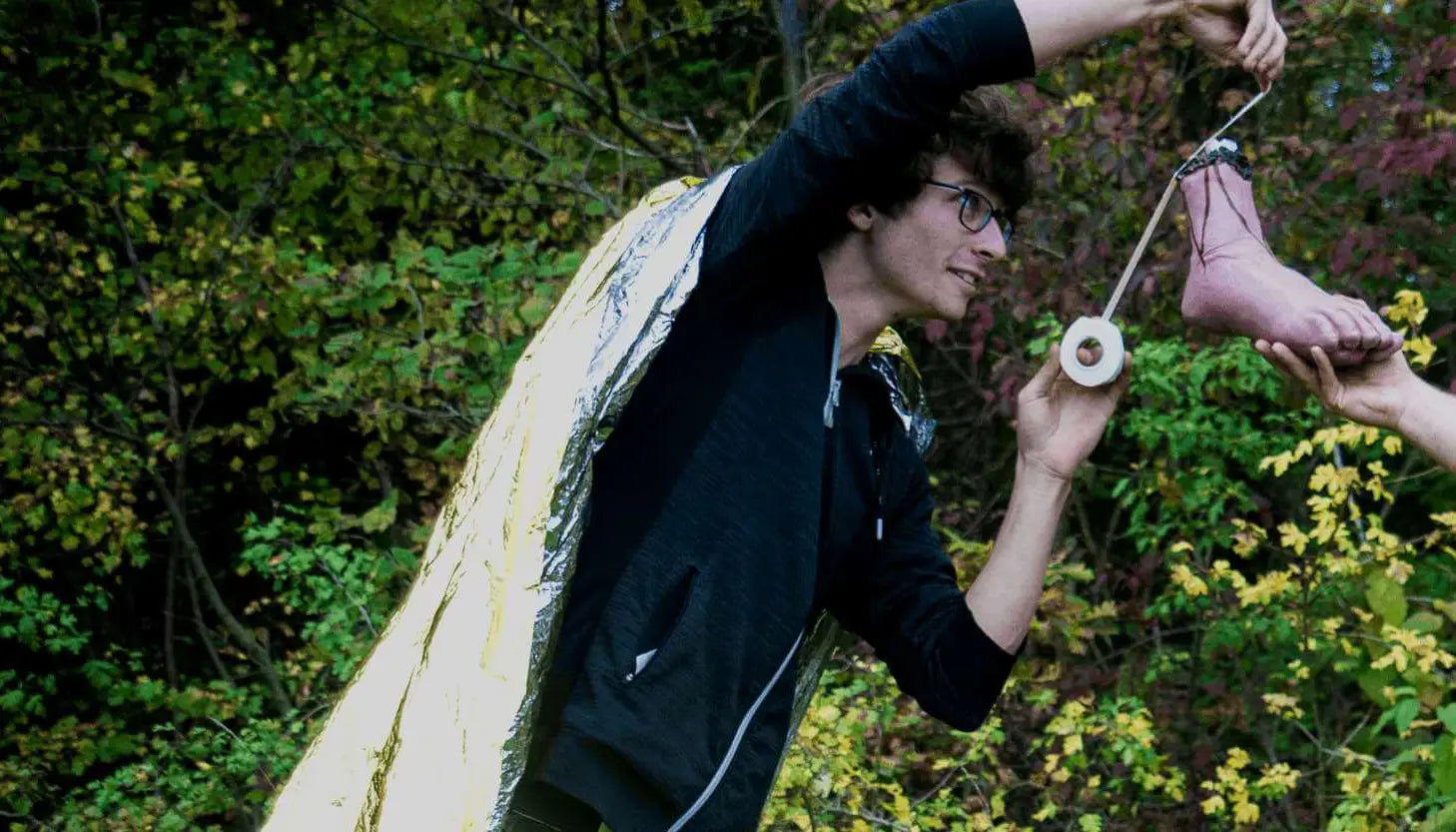
The sentence about the broken leg and the branch immediately pushes outdoor first aid into the realm of slightly crazy nerds and woodsmen. Merten and I would certainly agree with the nerd part. But simply attaching a stick to the leg isn't enough.
Outdoor first aid is actually called that only because people in nature inevitably encounter medical problems more often.
It's less stressful and more beneficial to be self-sufficient. You could also call it advanced first aid or everyday medical assistance. While the first term is already taken, "everyday assistance" often falls short. Nevertheless, it's commonplace, inevitably leading to a self-reinforcing spiral of medical knowledge. This knowledge then seeps unnoticed into many areas of life. The more problems I can solve independently, the less daunting larger undertakings seem. At the same time, even a minimal amount of basic knowledge dramatically combats feelings of helplessness when confronted. This applies to all disciplines, whether it's wilderness medicine, cooking, or DIY. It's also a very rewarding feeling not to have to rush to the doctor for a tick, a minor burn, or a wound. Or simply to know when you should see a doctor. A striking example: Do you know the symptoms of a heart attack? Ultimately, one in three people in Germany dies from it, and a good proportion of these deaths could be prevented through early detection and treatment (1).
As a basic idea of what Hinterland Medics considers outdoor first aid, we looked at statistics like these:
In the next step, we considered how to elegantly solve these problems in nature. It's important to remember that basic injury patterns and illnesses always require the same initial treatment, whether outdoors or at home. In the case of diarrhea, it's essential to provide sufficient fluids, electrolytes, and glucose. Only the method of obtaining the water differs significantly. Thus, we have a relatively large overlap in treatment, ranging from minor wounds and colds to sports injuries – problems we encounter even outside of our adventures. But we've addressed them specifically in an outdoor context. Beyond the theoretical aspects, we also have a home-field advantage, as we personally and as team leaders at Wandermut undertake numerous challenging expeditions. There, we rigorously test our approaches and adapt our methods to the rigors of expedition life.
The second aspect is life-saving immediate measures.
Such problems are rare, but if you don't act correctly immediately, the victims could die. The combination of both factors makes them so dangerous. Therefore, we have the globally widespread xABCDE algorithm We used a system designed for the rapid recognition and treatment of life-threatening conditions. This system covers all common first aid problems, from spurting arterial bleeding and airway obstruction to altered states of consciousness and environmental factors. It includes everything that can quickly lead to our demise. We've adapted this algorithm for laypersons, and Merten has given it a didactic approach that ensures this knowledge remains readily applicable, even years later, under stressful circumstances.
At this point, we begin to unleash our inner nerd (a term for people with special interests).
Merten is passionate about knowledge transfer like no other and is constantly working to optimize it. His main profession is actually teaching, and he enthusiastically trains school first aiders and youth groups in first aid. Every time Merten tries out a new teaching concept and sees that his students' results are better than before, his eyes light up with a joy usually only seen in three-year-olds on Christmas Eve.
I've been practicing medicine for over 10 years. Not because I have to, but because I'm passionate about it. My journey has taken me from emergency medical services to physiotherapy, herbal medicine, and gurus in the Far East. And ultimately, it led me to medical school. Always on an open-minded quest to find what works.
Our shared passion is the outdoors in extreme conditions. We're all about what's commonly referred to as outdoor masochism: spending weeks far in the backcountry, away from civilization, preferably in hostile environments. And that's the standard we apply to our courses. We don't base our courses on the Alps or German forests, but on the Pamir or the Amazon. We take our everyday problems and emergencies and then transpose them into situations where you have to fend for yourself for hours or even days. These are the exciting scenarios that personally fascinate us. Of course, we can then scale them down to local conditions. But topics like what belongs in an expedition first-aid kit or an outdoor first-aid set, how to provide or organize help, and how to build an emergency bivouac are simply fun for us. Especially when we (slightly exaggerating)  ) solve at the isolation level of Antarctica.
For us, all of this is wilderness medicine.
Like Max, who recognized his father's heart attack after our golf course and took him straight to the hospital. Or Matti, who handled a traffic accident involving five people in Thailand and potentially saved the life of someone with critical bleeding. Or Isi, who demonstrated fantastic bladder management in the Sahara, preventing several fellow campers from having to evacuate. These are medical and outdoor skills that can save lives or make them more comfortable, turn dreams into goals, and broaden one's horizons.
However, what this whole thing is not is a stick in the leg.